

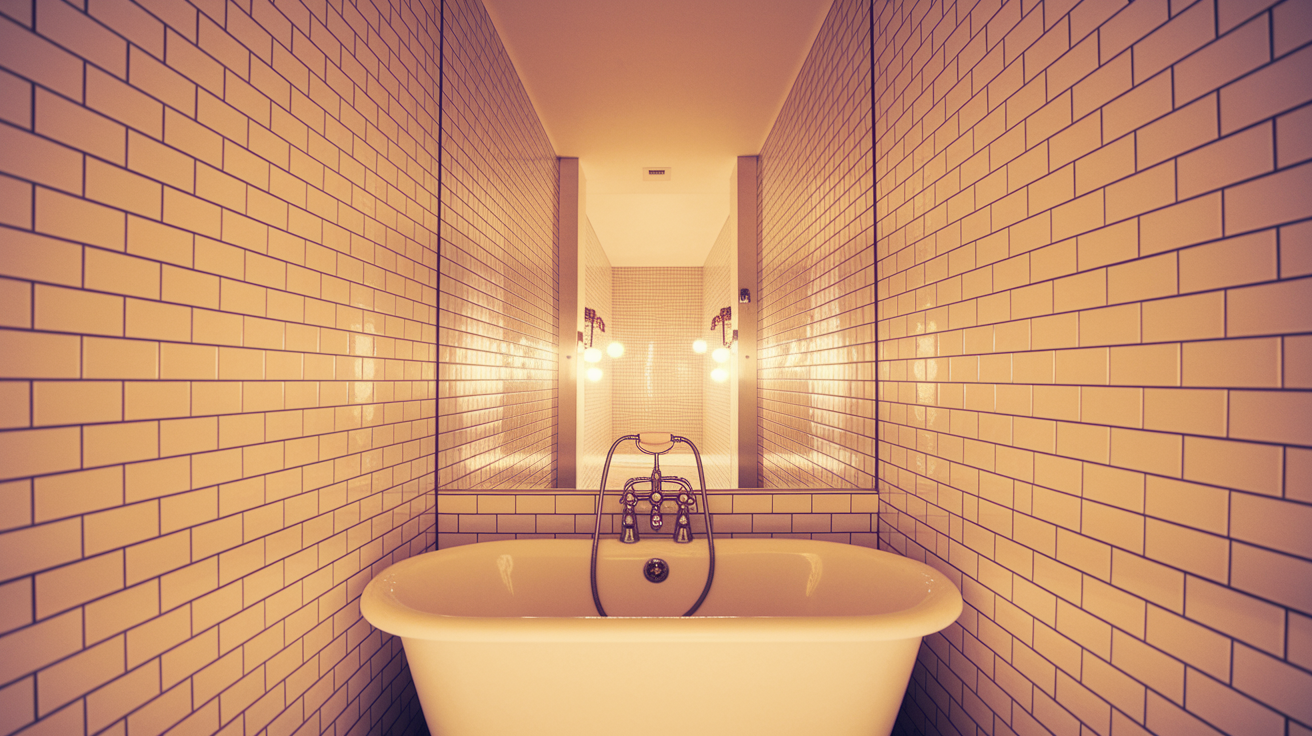

A small bathroom doesn’t have to feel cramped, and you don’t need a renovation to prove it.
With a few bright color choices, smart mirrors, layered lighting, compact fixtures, and clever storage, even the tiniest bath can feel calm and roomy.
This post walks you through simple, budget-friendly changes that make a real difference in days or a weekend.
You’ll get exact ideas you can use right away, plus mistakes to avoid so you don’t waste time or money.
Read on and start using every inch.
Smart Design Foundations for Small Bathroom Decor
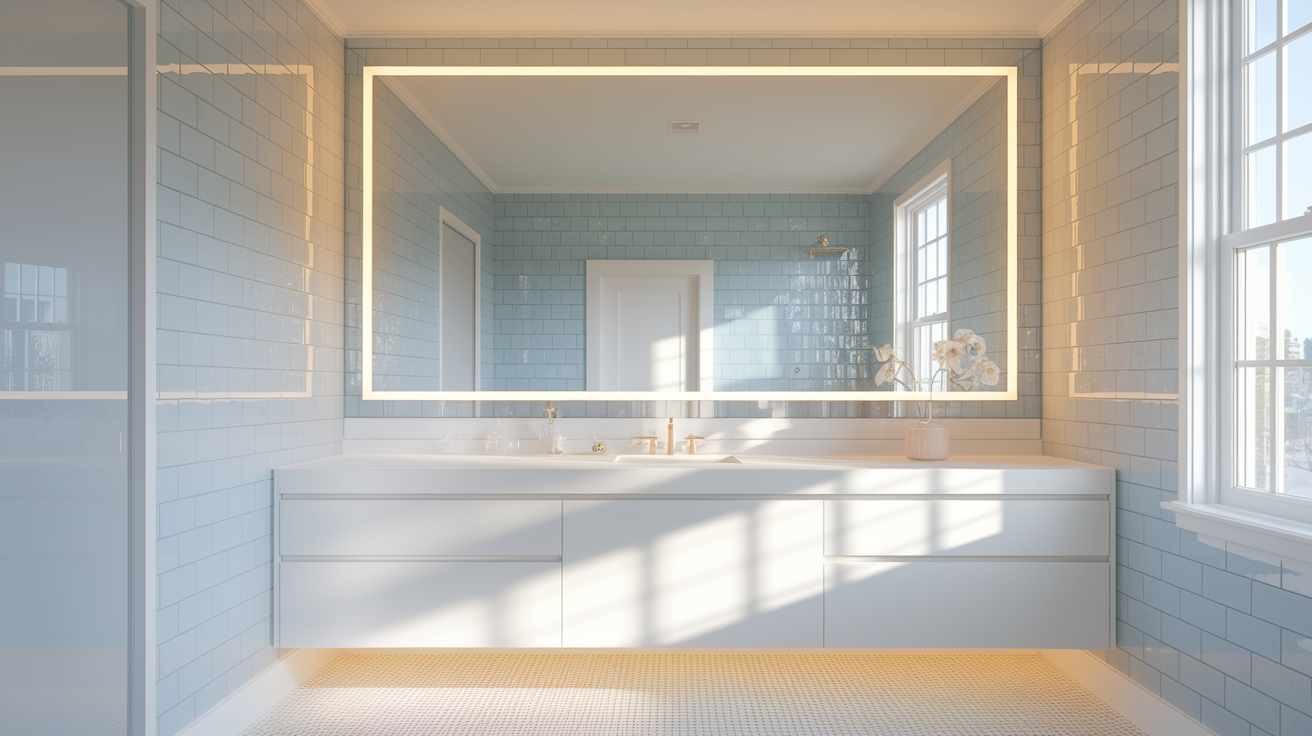
Light colors expand how big a space feels by bouncing natural and artificial light across walls and fixtures. Warm whites, pale grays, soft blues. They keep things open and airy. High-gloss or satin finishes reflect light and create subtle depth. A palette with less than 20 percent contrast in value lets your eye move smoothly across the room without hitting color breaks or hard edges. Walk into a tiny bathroom painted one soft hue and you’ll feel it right away. Walls seem to recede. The ceiling lifts.
Mirrors and lighting completely change small rooms by creating reflections and wiping out dim corners. Full-width mirrors over vanities visually double the depth of the space, while LED fixtures rated between 2,700 and 3,500 K provide bright, flattering light that enhances skin tone and brightens every surface. Position sconces or pendants so they reflect off mirrors and tile. That creates layers of light that reduce shadows and make the room feel larger. Clear sightlines reduce visual clutter. When you can see straight through a frameless glass shower or across an uninterrupted wall, your brain reads the room as bigger than it is.
Before adding decor or accessories, focus on five foundational improvements that maximize space and brightness:
- Apply light, high-gloss or satin paint to walls and trim to reflect more light.
- Install a full-width or wall-to-wall mirror to visually double the room’s depth.
- Replace dim fixtures with LED lighting that delivers 1,000 to 2,000 lumens at the vanity.
- Declutter countertops and shelves so only daily-use items remain visible.
- Choose large-format tiles to reduce grout lines and create a seamless, expansive feel.
Color and Finish Techniques for Small Bathroom Decor

Light hues reflect more natural and artificial light. Walls appear farther apart. Ceilings seem higher. Monochrome palettes reduce visual breaks. When floors, walls, and fixtures share a single color family, the eye travels across the room without interruption. That increases perceived square footage. High-gloss paint creates mirrored reflections that make tiny bathrooms feel deeper, especially in windowless or low-light spaces. Satin or semi-gloss finishes work well in high-moisture areas and still deliver a subtle sheen that brightens corners. One gallon of paint typically covers 350 to 400 square feet, so a single small bathroom needs about one gallon for walls and trim.
Large-format tiles minimize grout lines to enlarge perceived area and reduce visual busyness. Tiles sized 12 by 24 inches or 18 by 36 inches create fewer seams than smaller mosaics. The floor or wall reads as a single unbroken plane. Choose grout that’s close in color to the tile. Contrast under 10 percent improves the seamless effect. Moisture-resistant paint rated for bathrooms prevents mildew and maintains finish quality in high-humidity conditions. Look for paints labeled as kitchen-and-bath or mildew-resistant when shopping.
| Finish Type | Visual Effect | Best Placement |
|---|---|---|
| High-gloss paint | Mirrors light and creates depth | Small or windowless bathrooms; trim and doors |
| Satin/semi-gloss paint | Reflects light subtly; easy to clean | Walls and ceilings in high-moisture areas |
| Large-format tile (12″ x 24″+) | Reduces grout lines; reads as larger surface | Floors, shower walls, or full wall-to-ceiling installations |
Stick to one or two finishes and keep the palette simple. You don’t want to overwhelm a tight footprint.
Mirrors and Lighting Approaches That Enlarge Small Bathrooms
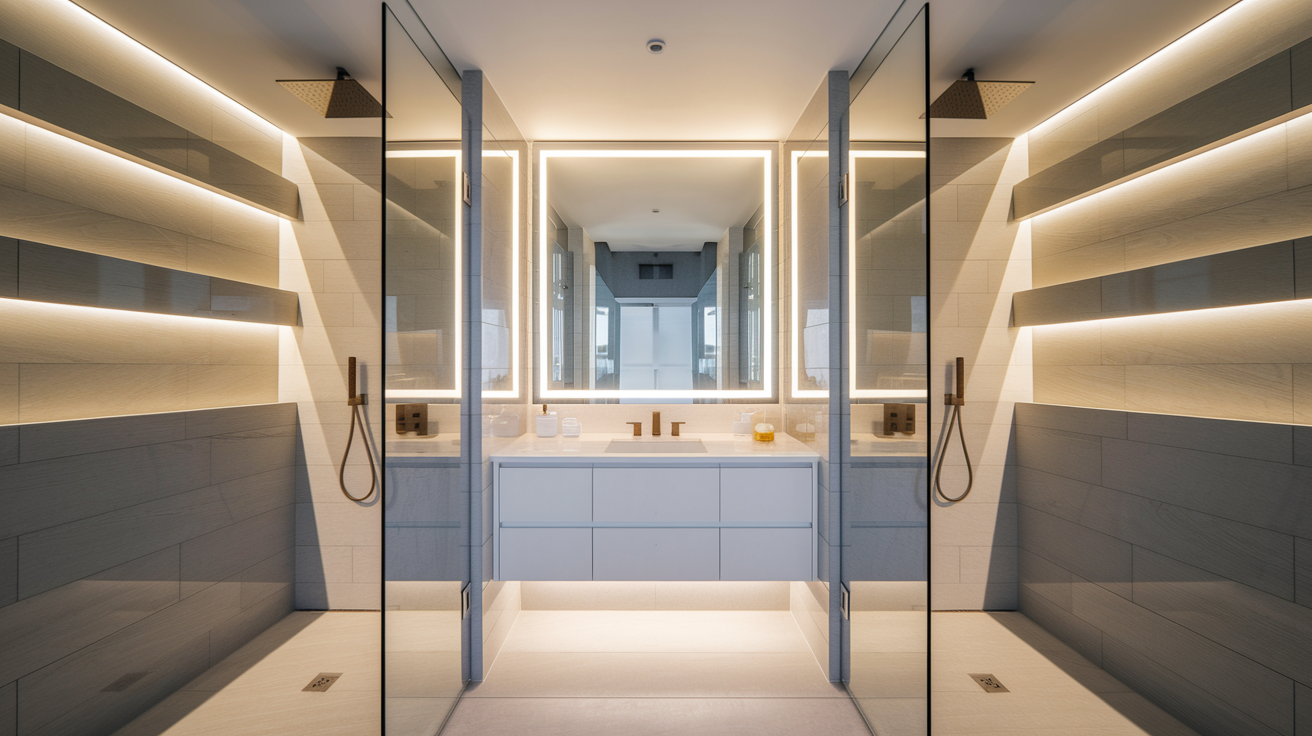
Mirrors add depth and brightness by reflecting both natural light from windows and artificial light from fixtures. Small bathrooms instantly feel more spacious. Full-width mirrors installed over vanities create the illusion that the wall extends beyond its actual boundary, while wall-to-wall or floor-to-ceiling mirrors visually double the room’s perceived size. Backlit mirrors reduce the need for bulky sconces and deliver soft, even light that flatters skin tone and brightens the entire space. When mirrors are positioned to reflect light sources, they multiply brightness and reduce dark corners that make rooms feel cramped.
Layered lighting combines ambient, task, and accent fixtures to eliminate shadows and create a balanced, airy environment. Vanity task lighting should reach 1,000 to 2,000 lumens total for clear visibility during grooming. Ambient recessed or ceiling fixtures provide general room brightness. Pendant lights or dainty overhead fixtures can replace wall sconces when wall space is limited, adding style without taking up room near the mirror.
Ideal Mirror Placement
Mount the top edge of a vanity mirror 72 to 78 inches from the floor to maximize reflection height and make ceilings feel taller. For single-basin vanities, center the mirror over the sink with a width equal to the vanity width. That ensures balanced proportions. Wall-to-wall mirrors that extend from countertop to ceiling create continuous reflections that erase visual boundaries and open up tight spaces. When you can’t see where the mirror ends, the room feels limitless.
Layered Lighting for Tiny Bathrooms
Aim for LED color temperatures between 2,700 and 3,500 K for flattering, natural-looking light that enhances skin tone and brightens surfaces. Install vertical sconces 60 to 66 inches from the floor and 30 inches from the mirror’s centerline, or mount a horizontal fixture 6 to 12 inches above the mirror for even task lighting. Recessed ambient fixtures should be spaced 4 to 6 feet apart to provide consistent overhead brightness without creating harsh shadows. Dimmers rated for LED allow you to adjust light levels for different times of day and reduce energy use when full brightness isn’t needed.
Space-Saving Fixtures for Compact Bathroom Decor
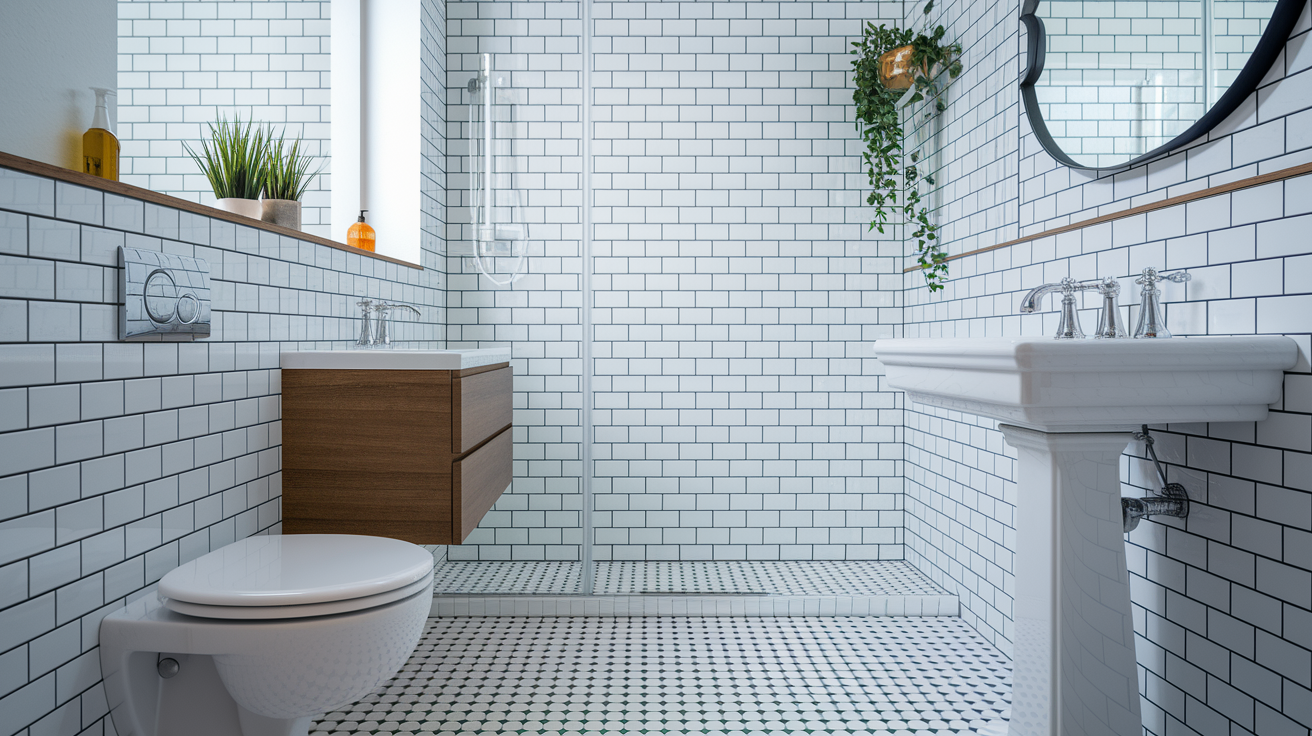
Choosing compact fixtures reclaims floor area and improves circulation in tight bathrooms where every inch counts. Smaller vanities, sinks, and toilets free up space for walkways and door swings without sacrificing functionality or style.
Narrow & Floating Vanities
Narrow vanities come in widths of 18, 20, and 24 inches with depths between 16 and 20 inches. They save valuable floor space compared to standard 30-inch models. Floating vanities mount directly to the wall at heights between 18 and 22 inches, freeing up floor area beneath and creating a lighter, more open look. The visible floor space beneath a floating vanity makes the room read larger, and the shallow depth allows for comfortable knee clearance of at least 30 inches. Typical costs for narrow floating vanities range from $200 to $600, depending on finish and storage features.
Corner & Pedestal Sinks
Pedestal sinks have footprints 18 to 24 inches wide and 16 to 20 inches deep. They replace bulky vanities in bathrooms where storage can be handled elsewhere. Corner sinks project only 12 to 16 inches from the corner, saving 6 to 12 inches of walkway space compared to traditional vanities. These compact options work well in powder rooms or tight layouts where floor clearance is more important than counter space. Pedestal sinks typically cost between $100 and $400. Corner models range from $150 to $500.
Compact & Wall-Mounted Toilets
Compact toilets with 24 to 28-inch projection save 3 to 6 inches compared to standard 28 to 30-inch models. They improve clearance in narrow bathrooms. Wall-mounted toilets free up even more floor area by hiding the tank inside the wall, creating a sleek, minimalist look and making floor cleaning easier. Rough-in measurements are typically 12 inches, though some compact models require 10-inch rough-ins. Measure before purchasing to avoid installation issues. Wall-mounted toilets cost between $400 and $1,000, while compact floor-mounted models range from $150 to $500.
| Fixture Type | Typical Dimensions | Footprint Savings vs. Standard |
|---|---|---|
| Narrow floating vanity | 18–24″ wide, 16–20″ deep | 6–12″ saved in depth or width |
| Corner sink | 12–16″ depth from corner | 6–12″ saved in walkway space |
| Wall-mounted toilet | 24–28″ projection | 3–6″ saved, plus open floor area |
Smart Storage and Organization for Small Bathroom Decor
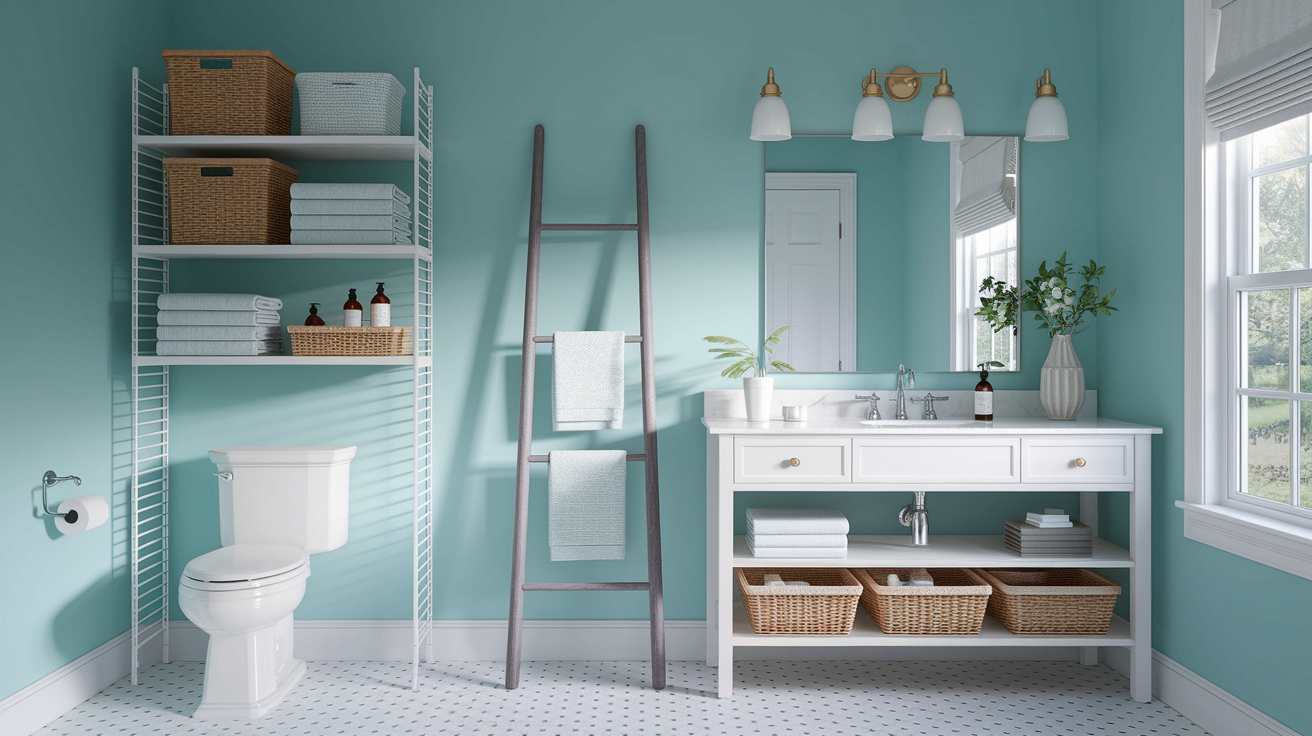
Vertical storage and closed cabinetry keep daily clutter out of sight and free up counter and floor space in small bathrooms. Over-toilet shelving units measure 12 to 14 inches deep and extend up to 72 inches from the floor. They provide room for three to four folded towels or six to eight toiletries per shelf without blocking access to the toilet. Floating shelves with depths between 8 and 12 inches and vertical spacing of 12 to 18 inches display small plants, jars, or decorative items while maintaining a clean, uncluttered look. Recessed medicine cabinets sized 14 by 16 by 4 inches or 16 by 24 by 4 inches save 3 to 4 inches of wall projection compared to surface-mounted cabinets and combine mirror function with hidden storage.
Ladder racks occupy a footprint of only 12 by 60 inches and hold two to three towels vertically, using minimal wall area while keeping towels within easy reach. Under-sink organization improves with pull-out trays 12 to 15 inches deep and spaced 6 to 8 inches apart, or lazy-susan turntables that increase accessible volume by 30 to 50 percent. Use four to six identical bins sized 6 by 9 by 4 inches inside a standard 18-inch cabinet. That keeps grooming tools, cleaning supplies, and extra toiletries sorted and visible. If everything has a labeled bin, you’ll actually put things away instead of leaving them on the counter.
Maximize storage without crowding your small bathroom with these six practical upgrades:
- Install an over-toilet shelving unit to store extra towels, toilet paper, and decorative baskets.
- Mount floating shelves 8 to 12 inches deep for small plants, jars, and daily-use items.
- Replace a surface-mounted mirror with a recessed medicine cabinet to hide grooming essentials.
- Add a vertical towel ladder that leans against the wall to save space and hold multiple towels.
- Use pull-out trays or lazy-susan organizers under the sink to reach all stored items easily.
- Keep only two to four hooks for robes, hand towels, and spare towels instead of bulky towel bars or shelves.
Shower, Door, and Layout Strategies for Small Bathroom Decor
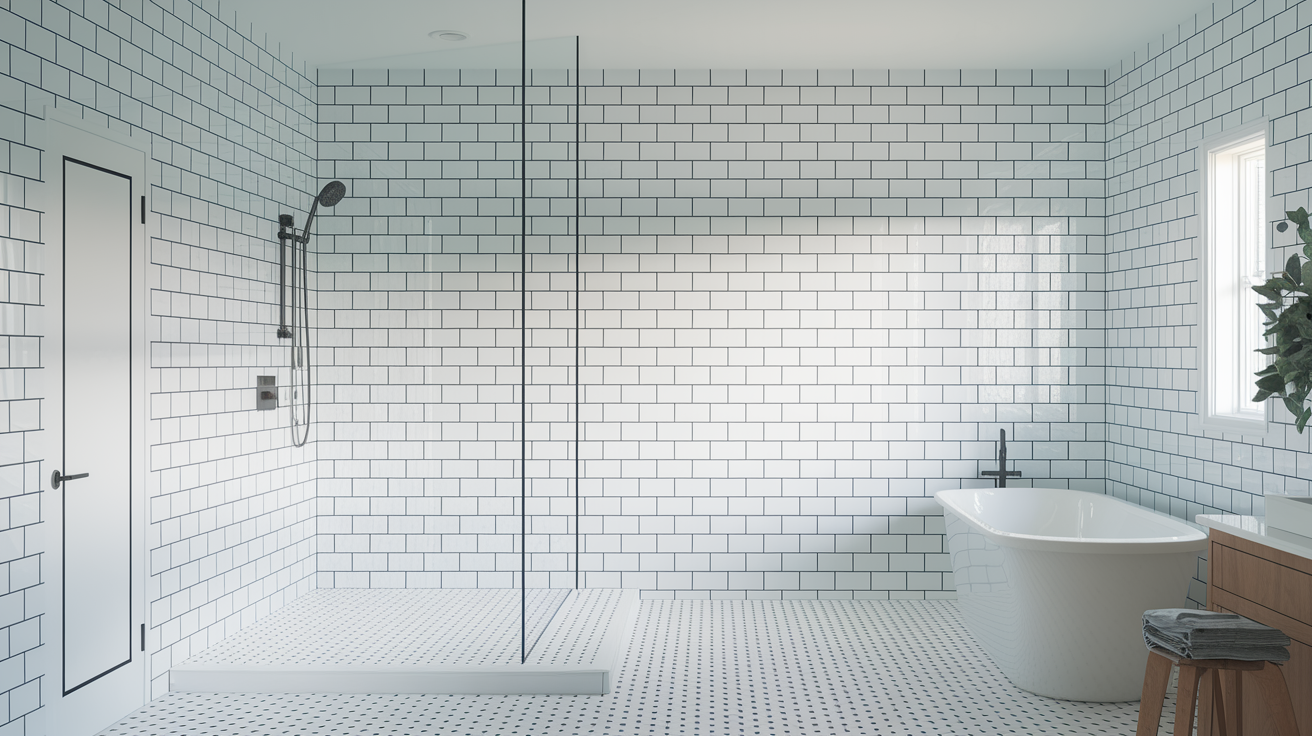
Frameless glass shower doors or clear enclosures boost sightlines by allowing the eye to travel across the full bathroom without interruption. Remove a shower curtain and install a glass door. You add visual depth and make the room feel more open and modern. Walk-in showers sized 30 to 36 inches reclaim 6 to 8 square feet compared to a standard 60-inch bathtub, freeing up floor area for improved circulation or additional storage. Corner shower enclosures fit neatly into unused corners and open up the center of the room for easier movement and door access.
Pocket doors slide into the wall cavity and cost between $300 and $1,200 installed, depending on wall construction and hardware quality. They eliminate the 30-inch door swing needed for traditional hinged doors, making them ideal for tight layouts where space is at a premium. Sliding barn doors require 2 to 3 inches of adjacent wall clearance but provide a stylish alternative when pocket installation isn’t feasible. Just keep in mind they offer less privacy and noise isolation than traditional or pocket doors.
Door and shower enclosure options for small bathrooms:
- Frameless glass shower door: creates a window-like effect and visually enlarges the room; costs $500 to $1,500 installed.
- Sliding shower door: saves space by eliminating outward swing; works in tight alcove showers.
- Pocket door: slides into wall cavity and eliminates door swing; requires wall framing modification.
- Barn door: mounts on track and slides along wall; saves swing space but reduces sound privacy.
Decor Accents and Styling Tips for Small Bathroom Decor
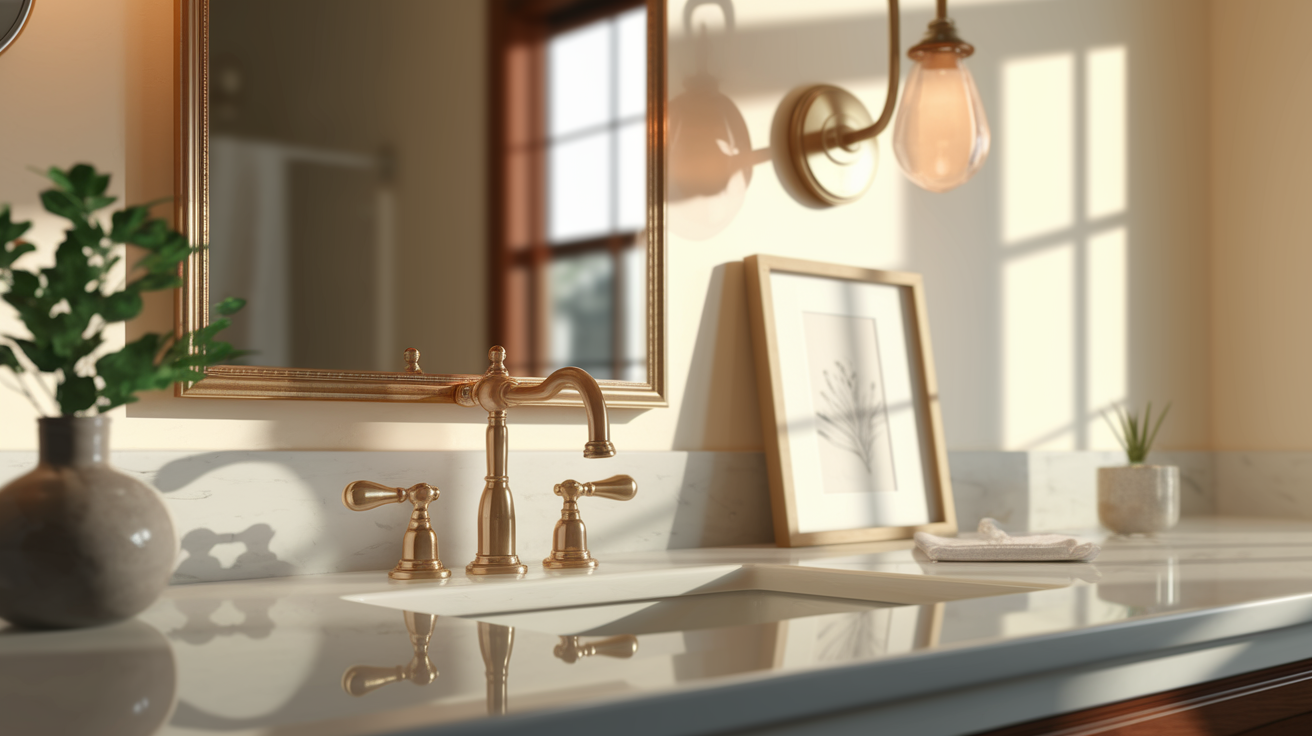
Brass hardware enhances cohesion and adds a refined accent when used consistently across faucets, towel bars, and light fixtures. Match all metal finishes, whether brass, chrome, matte black, or brushed nickel. That creates seamless lines that reduce visual clutter and make the room feel more intentional. Small plants like pothos, snake plants, or ferns brighten windowless rooms and add a pop of natural color without taking up valuable counter space. Limit décor to a few impactful items. One plant. A small tray for soap and lotion. Maybe a single piece of framed artwork. Let fixtures and finishes remain the focal points.
Shallow floating shelves 8 to 12 inches deep hold a few decorative jars, folded hand towels, or small candles without crowding the walls or blocking sightlines. Hooks and pegs mounted on the back of the door or on unused wall space keep robes and towels accessible while freeing up towel bars for daily-use linens. Two or three simple hooks can handle everything without adding bulk.
Simple accents that enhance small bathroom decor:
- One or two small plants in ceramic pots to add color and texture.
- Matching brass or matte-black hardware across all fixtures for a cohesive look.
- A single piece of framed artwork or a small mirror on an accent wall.
- Two to four decorative hooks for towels and robes instead of bulky shelving.
Budget-Friendly & DIY Small Bathroom Decor Improvements
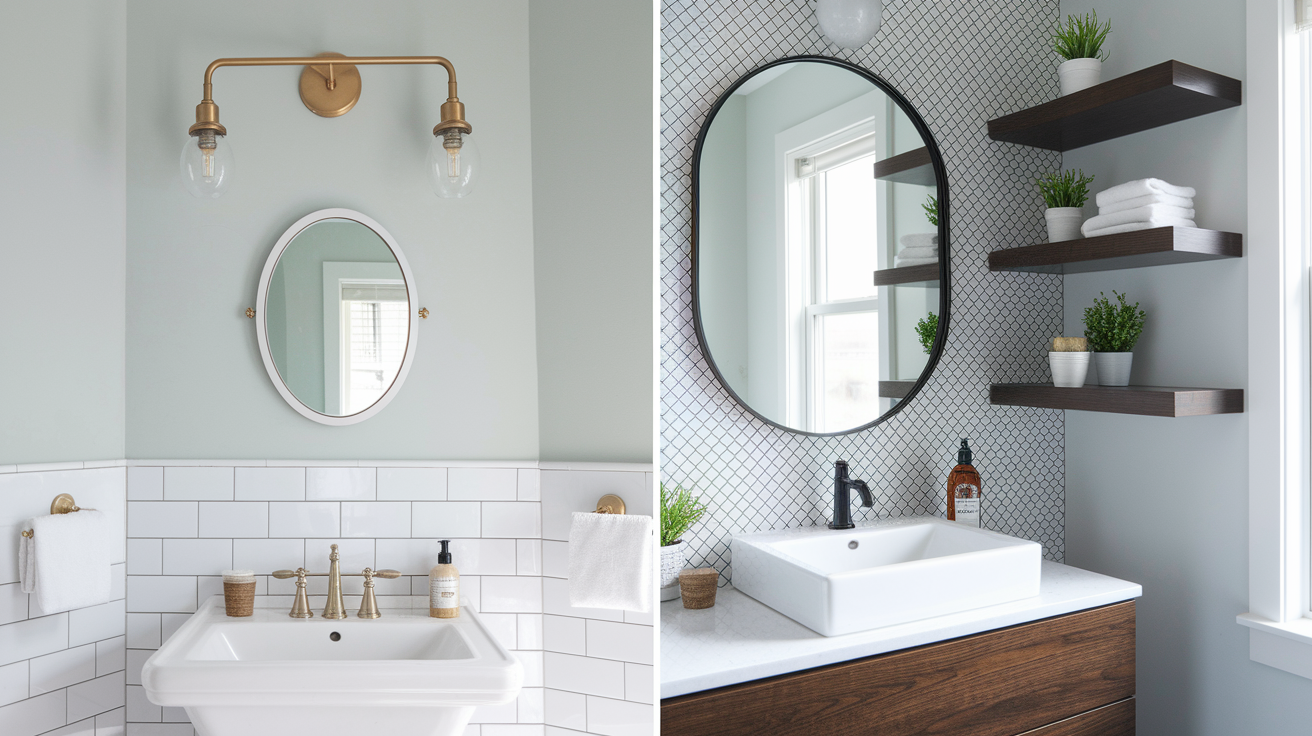
Quick cosmetic refreshes cost between $50 and $300 and take 4 to 16 hours. They’re accessible DIY projects for most homeowners. Peel-and-stick tile backsplash kits range from $20 to $60 and cover 6 to 12 square feet, allowing renters and budget-conscious decorators to update walls without permanent changes. Common DIY tasks include swapping mirrors, repainting walls and trim, installing new hooks or towel bars, and organizing under-sink storage with bins and pull-out trays. Decluttering systems that use matching baskets and labeled containers immediately increase perceived space by reducing visible items. Clear the counter and put eight small bottles into two bins. The bathroom feels twice as big.
Replace a basic mirror with a larger framed or frameless model for $25 to $150. It takes about an hour to hang and instantly brightens and enlarges the room. Paint walls and trim with moisture-resistant paint in a light, cohesive palette. You’ll need one gallon at $25 to $50 and a weekend’s work for most small bathrooms. Add a few slim floating shelves or a vertical towel ladder for $30 to $100 in materials. It takes one to two hours to install and delivers functional storage without major construction or expense.
| DIY Project | Cost Range | Time Required |
|---|---|---|
| Peel-and-stick backsplash installation | $20–$60 | 2–4 hours |
| Paint walls and trim (one gallon) | $25–$50 | 4–8 hours |
| Mirror swap and mounting | $25–$150 | 1 hour |
Final Words
Start by using light color palettes, bright or high-gloss finishes, and a full-width mirror to open the room. Layer LED task and ambient lighting so corners don’t disappear.
Choose compact fixtures like floating vanities or corner sinks, clear glass shower doors, and simple vertical storage. Large-format tile and fewer grout lines help reduce visual clutter.
These practical moves bring the biggest payoff for bathroom decor small space, fast, affordable, and doable in weekend chunks. You’ll end up with a bathroom that feels brighter, bigger, and more useful.
FAQ
Q: How do I decorate a very small bathroom?
A: To decorate a very small bathroom, use light colors, a wall-to-wall mirror, compact fixtures, clear sightlines, and simple, tidy storage to make it feel larger and work better.
Q: What to put in a small space in a bathroom?
A: In a small bathroom, put slim storage like floating shelves or a recessed cabinet, a narrow or wall-mounted vanity, hooks, a clear shower door, and a large mirror to save floor space.
Q: What color is most flattering in a bathroom?
A: The most flattering bathroom colors are light warm neutrals or soft whites because they reflect light and flatter skin tones; pair them with 2,700–3,500 K lighting for the best results.
Q: What is the current trend for bathrooms?
A: The current bathroom trend favors light, minimal layouts with large mirrors, frameless glass showers, floating vanities, mixed metal or brass accents, and simple palettes that make rooms feel brighter and airier.